
Diclofenac has been around long enough that the clinical track record is settled. It blocks COX-1 and COX-2, reduces prostaglandin synthesis at the injury or inflammation site, and tends to carry a stronger anti-inflammatory effect than ibuprofen or naproxen at comparable doses. That’s why it’s stayed the first-line NSAID choice in clinical settings for inflammatory pain even as newer options have come along.
The formulation you choose depends on what you’re treating. Immediate-release for acute, short-term pain. Enteric-coated or extended-release when daily dosing is needed and GI tolerability matters.
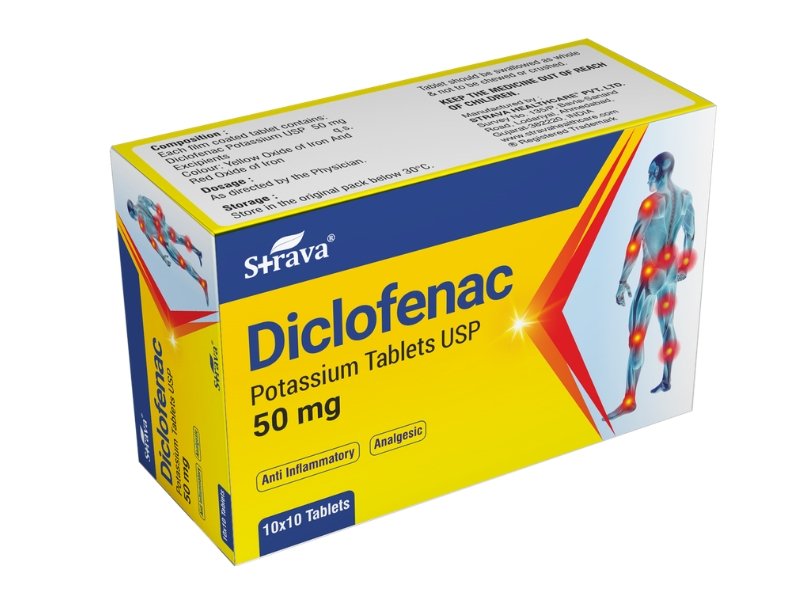
Strava Healthcare manufactures diclofenac tablets in India sodium and potassium salts, in immediate-release, enteric-coated, and extended-release formats for pharmaceutical distributors, hospital chains, and export markets.
Diclofenac is exported to countries like Ghana, Angola, Nigeria, Sudan, South Sudan, Somalia, Kenya, Uganda, Kenya, Cambodia, Cameroon, Chile, Colombia, DRC Congo, Djibouti, and Dominic republic, Iran, Kazakhstan, Lesotho, Malawi, Myanmar and Niger.
Indications
Rheumatoid arthritis, osteoarthritis, ankylosing spondylitis, acute musculoskeletal and sports injuries, dysmenorrhoea, post-operative and post-dental pain, acute migraine, short-term renal colic.
Salt form and formulation: what actually differs?
Diclofenac sodium is the standard. Slower solubility, which is why it works well in enteric-coated and SR formats designed for controlled, sustained release.
Diclofenac potassium dissolves faster. That quicker solubility means faster absorption and faster onset relevant when the clinical need is speed. Dysmenorrhoea, dental pain, acute headache. If the product is targeting any of those, potassium is usually the better call.
Extended-release at 100 mg once daily is the chronic-use format. Lower peak plasma concentration than immediate-release, which translates to better tolerability over months of daily use.
Manufacturing
GMP-certified. Batch testing covers diclofenac assay, dissolution profile, content uniformity, related substances, and microbiological purity. Enteric-coated tablet coating processes are validated against pharmacopoeial acid-resistance specifications. Third-party COAs on request.
B2B and pharma partners
Contract manufacturing with custom salt form, coating type, strength, branding, and pack configurations. Private label diclofenac tablets. Bulk supply for pharma distributors, hospital chains, and regulated export.
Product Specifications
| Parameter | Details |
|---|---|
| Active Ingredient | Diclofenac Sodium / Diclofenac Potassium |
| Strengths | 25 mg / 50 mg / 75 mg (IR/EC); 100 mg (SR/ER) |
| Dosage Form | Film-coated / Enteric-coated / Extended-release tablet |
| Pack sizes | 10s, 15s blister; 100s, 500s bottle |
| Storage | Storage Below 30°C, protected from moisture |
| Shelf Life | 24 months |
Frequently Asked Questions
Therapeutic target first, then formulation. Chronic arthritis or ongoing musculoskeletal conditions sodium salt, enteric-coated or SR. Acute pain where onset time matters potassium salt. If you’re unsure which formulation fits the clinical profile, share the indication and we’ll work through it.
Anti-inflammatory potency: diclofenac is generally stronger at equivalent doses that’s why it’s the more common clinical prescription choice for inflammatory pain. GI profile: ibuprofen is somewhat gentler, particularly at lower OTC doses, and has a longer safety record in that context. Cardiovascular risk: both carry some signal with long-term use, but diclofenac’s is modestly higher. For a patient with existing cardiac risk factors on long-term therapy, that difference is worth factoring in. For short-course use in otherwise healthy adults, the distinction is less clinically meaningful.
For acute short-course use, no standard diclofenac taken with food handles GI tolerability well enough. The enteric coating earns its cost when patients are taking the drug daily for months. Chronic arthritis patients drop off therapy partly because of GI discomfort. Enteric coating reduces that enough to make a difference in real-world adherence. If the target population is chronic pain, it’s worth the cost. If it’s acute use, it’s not.
Diclofenac 50 mg + Paracetamol 500 mg Tablets Manufacturer
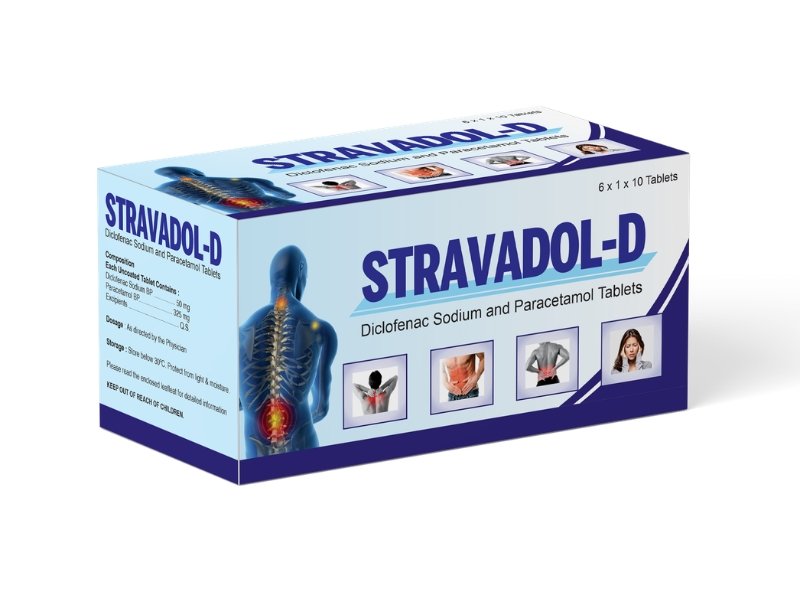
Diclofenac handles the inflammation. Paracetamol handles the pain centrally. They don’t overlap much mechanically, which is exactly why the combination works you’re not doubling up on the same pathway, you’re covering two different ones at once. In practice, that often means better analgesia at lower individual doses than you’d need with either drug alone.
Musculoskeletal pain, post-surgical pain, dental pain, dysmenorrhoea these are the common use cases. All situations where you’re dealing with both an inflammatory component and a baseline pain response that needs addressing.
Strava Healthcare manufactures Diclofenac 50 mg + paracetamol 500 mg tablets in India for pharmaceutical distributors, hospital pharmacies, and export markets. GMP-certified, full batch documentation.
Pregabalin is exported to countries like Ghana, Angola, Nigeria, Sudan, South Sudan, Somalia, Kenya, Uganda, Kenya, Cambodia, Cameroon, Chile, Bolivia, Colombia, DRC Congo, Djibouti, and Dominic republic, Iran, Kazakhstan, Uzbekistan, Lesotho, Malawi, Myanmar and Niger.
Indications
Osteoarthritis, back pain, soft tissue injuries, post-operative pain, dental and or facial pain, primary dysmenorrhoea, headache and migraine with an inflammatory component, short-course acute gout.
Dosing and contraindications
One tablet two to three times daily with food. Shortest effective course. Contraindicated in peptic ulcer disease, severe renal impairment, and known NSAID hypersensitivity. Third trimester of pregnancy is an absolute contraindication for the diclofenac component — not a relative one. Longer-term use needs GI, renal, and cardiovascular monitoring.
Manufacturing
GMP-certified. Each batch is tested for assay of both actives, content uniformity, dissolution profile for both APIs, related substances, and microbiological purity. Validated release processes across batches.
For B2B and pharma buyers
Contract manufacturing with custom branding, pack sizes, and packaging. Private label tablets. Bulk supply for pharma distributors, hospital chains, and export.
Product Specifications
| Parameter | Details |
|---|---|
| Active Ingredient | Diclofenac Sodium 50 mg + Paracetamol 500 mg |
| Dosage Form | Film-coated tablet |
| Pack sizes | 10s, 15s blister; 100s, 500s bottle |
| Storage | Below 30°C, protected from moisture |
| Shelf Life | 36 months |
Frequently Asked Questions
One tablet. That’s most of the answer. Compliance drops when patients are managing two separate products, especially for short-course acute pain where adherence is already inconsistent. Beyond that, the fixed combination tends to use lower individual doses of each drug which may reduce side effect burden compared to running either at full monotherapy dose. For conditions with mixed inflammatory and nociceptive components, it’s just the more practical formulation.
Yes, and this is worth actually explaining to patients rather than just saying “take with food.” Diclofenac suppresses COX-1, which is part of how the gastric mucosa protects itself. On an empty stomach, that protection is already reduced before the drug even arrives. Food or even a glass of milk cuts the irritation risk without affecting the analgesia. It’s a small instruction that makes a real difference in tolerability.
Caution is warranted, but “caution” means different things depending on the patient. Controlled hypertension on stable medication — short-course use is generally manageable with monitoring. Uncontrolled hypertension — avoid. Patients on ACE inhibitors or ARBs this is where it gets more specific. NSAIDs interfere with renal prostaglandin pathways that those drugs depend on. The interaction isn’t just a labelling concern; it can genuinely reduce antihypertensive efficacy and affect renal function. Worth a proper conversation rather than a blanket clearance.
Yes. Dossier support and COPP for regulated and semi-regulated markets.