
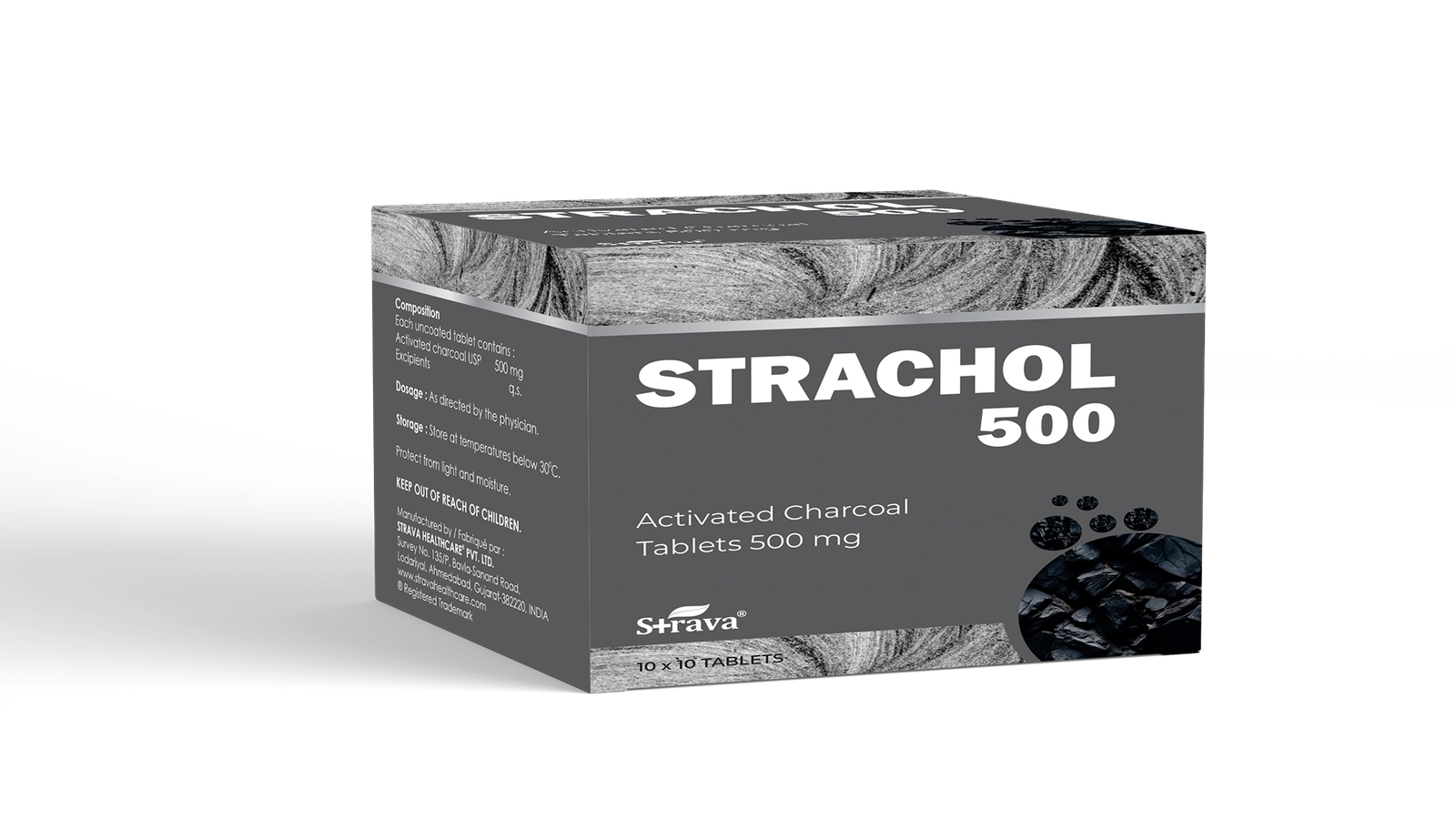
Strava Healthcare makes activated charcoal capsules for pharmaceutical distributors, nutraceutical brands, and private label buyers.Activated charcoal starts as coconut shell or wood, heated in the presence of gas until it develops a porous structure with a surface area that sounds implausible until you look it up. That surface area is the whole point: it adsorbs a wide range of organic compounds in the gut before they’re absorbed, then passes through unchanged. The clinical use is specific and time-sensitive it’s a legitimate emergency intervention for certain acute oral poisonings, but only within 1 to 2 hours of ingestion. The wellness market uses it for bloating, gut detox, and digestive support, where the evidence is thinner but not non-existent. We supply to both.
Activated charcoal tablets and capsules are widely used in United Kingdom, China, Indonesia, Vietnam, Philippines, Thailand, Malaysia, Nigeria, Somalia, Kenya, Ghana, Tanzania, Ethiopia and Burundi.
Applications
- Acute poisoning management clinical use, within 1 to 2 hours of ingestion
- Bloating and gas adsorbs intestinal gases and fermentation byproducts
- General gut detoxification wellness positioning
- Hangover and dietary indiscretion support consumer market
- Traveller's digestive support
Key Features
- Coconut shell (food-grade) or wood source specify at enquiry
- Standard strengths: 250 mg, 500 mg per capsule
- Gelatin and vegetable capsule formats
- GMP manufacturing with identity, assay, and surface area testing
- Private label and contract manufacturing available
Product Specifications
| Parameter | Details |
|---|---|
| Active Ingredient | Activated charcoal (coconut shell or wood source) |
| Strength per Capsule | 250 mg / 500 mg |
| Dosage Form | Hard gelatin capsule / Vegetable capsule / Tablets |
| Packaging | Bottles of 30s, 60s, 90s; bulk |
| Storage | Cool, dry — away from moisture and strong odours |
| Shelf Life | 36 months |
| Manufacturer | Strava Healthcare Private Limited |
Frequently Asked Questions
Yes, and it’s worth being direct about this. Activated charcoal doesn’t distinguish between a toxin and a drug — it adsorbs both. Anyone on prescription medication should separate it by at least 2 hours, and that warning belongs on the product label for wellness use. In acute poisoning scenarios, drug interaction is factored into the clinical decision. It’s not a reason to avoid the product; it’s just something that needs to be on the label and in the prescriber’s awareness.
There are small controlled trials showing reduced flatulence and bloating with supplementation. The effect sizes are modest. The mechanism is straightforward — gas gets adsorbed before it causes discomfort. It won’t fix whatever is causing the bloating, but as a symptomatic product it has a plausible rationale and some data behind it. That’s a reasonable position for an OTC claim.