
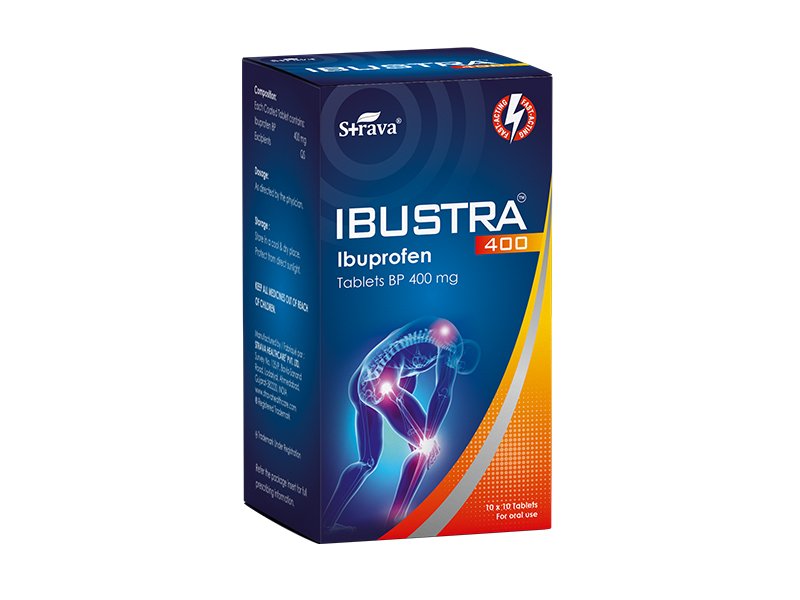
Strava Healthcare is a prominent manufacturer of ibuprofen tablets in India for pharmaceutical distributors, hospital chains, and for export markets. The supremacy of Ibuprofen is it blocks COX-1 and COX-2, which stops prostaglandin production that is reason it handles pain, fever, and inflammation, where paracetamol only covers two of the three. It is on the WHO Essential Medicines List and one of the most prescribed analgesics globally. Ibuprofen is more in demand in African counties like Mali, Ivory coast, Angola, DRC Congo, Senegal, Ghana, Burundi and ASEAN countries like Myanmar and Cambodia and CIS countries like Uzbekistan, Armenia, Tajikistan, Turkmenistan, Azerbaijan.
Every batch is GMP-manufactured with assay, dissolution, content uniformity, and microbiological purity testing. This product is for pharmaceutical B2B distribution only.
Indications
- Headache, dental pain, dysmenorrhoea, musculoskeletal pain
- Fever in adults and children
- Rheumatoid arthritis and osteoarthritis
- Postoperative pain and soft tissue inflammation
- Acute migraine
For B2B and Pharma Partners
- Contract manufacturing: custom strengths, branding, and packaging
- Private label: film-coated tablets ready for market
- Bulk supply for domestic and international distributors
Product Specifications
| Parameter | Details |
|---|---|
Active Ingredient |
Ibuprofen |
Strengths |
200 mg / 400 mg / 600 mg / 800 mg |
Dosage Form |
Film-coated tablet |
Packaging Sizes |
Blisters of 10s, 20s; bottles of 100s, 500s |
Storage |
Below 30°C, protected from moisture |
Shelf Life |
36 months |
Manufacturer |
Strava Healthcare Private Limited |
Frequently Asked Questions
Yes. COX-1 helps protect the stomach lining, and ibuprofen suppresses it. On an empty stomach there is nothing buffering that effect, and GI discomfort follows fairly reliably. Food or milk alongside the dose reduces that risk.
For self-medication, 1,200 mg per day. In clinical settings managing arthritis, for example doses goes up to 2,400 to 3,200 mg per day but are used, and that needs medical supervision and regular monitoring. It is not a self-managed dose.
Yes, and the third trimester is where the risk is most concrete. NSAIDs at that stage can trigger premature closure of the ductus arteriosus and cause foetal renal complications. It should be avoided unless a physician has specifically said otherwise.